




Micromechanical Modelling of Composite Materials
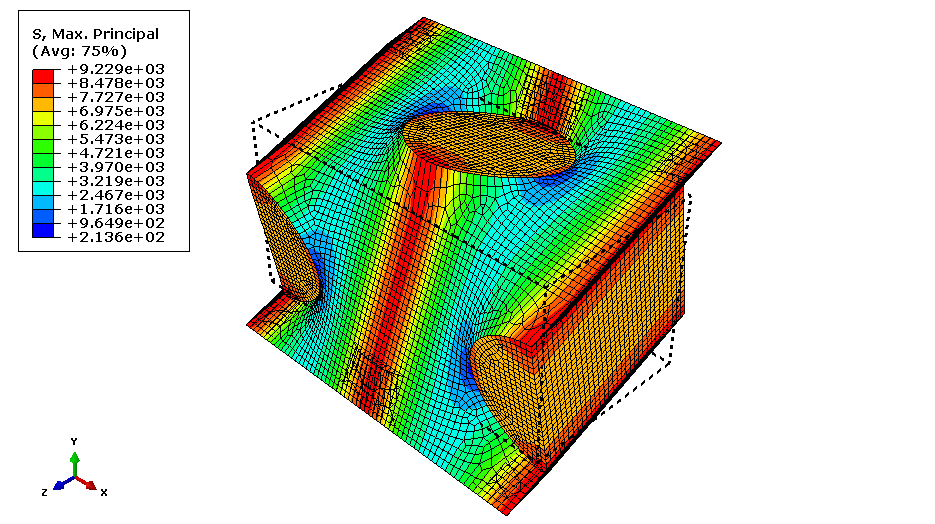
In this study, micromechanical models of composite materials are created by finite elements method. In micromechanical modelling, composite materials are modelled in its constituents' level and its macro-level (overall) properties are obtained . The most important consideration is Representative Volume Element (RVE). Placing fiber in resin is arranged according to square or hexagonal geometry considerations. Then, various load modes are applied to the model under appropriate periodic boundary conditions. Elastic moduli of composite are obtained under these load modes (E1, E2, E3, G12, G13, G23, v12, v13, v23).
"Cure kinetics" properties and "cure shrinkage" values, obtained in a previous study [1], are implemented to the finite element model by using "user-defined subroutine". Mechanical properties and residual stress generation throughout cure cycle are investigated. Also, coefficients of thermal expansion values of composite are calculated by using the thermal contraction at the end of the cure cycle.
Progressive failure analysis is applied to the micromechanical model and it is subjected to various load modes again. Fiber is always assumed to behave brittle, however resin is assumed to be ductile or brittle. Various yield and failure criteria are applied according to these assumptions and mechanical behavior of composite material is investigated with progressive failure analysis.
The values predicted within this study are compared with experimental results and good agreement is obtained between each other. In order to prove this study can provide better agreement, the load level at which resin crack initiates must be determined. Therefore, these experiments must be carried out with acoustic emmision machine. This study is progressin in this manner.
[1] N. Ersoy, T. Garstka, K. Potter, M.R. Wisnom, D. Porter, M. Clegg and G. Stringer “Development of the Properties of a Carbon Fibre Reinforced Thermosetting Composite Through Cure”, Composites: Part A, Vol. 41, No. 3 pp 401-409, 2010