



Ultrasonic Dispensing System
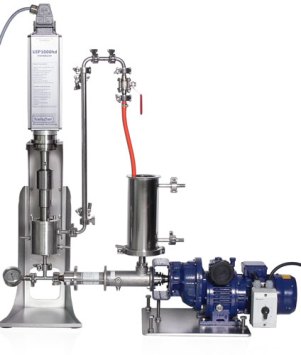 Nanocomposites will have potential fields of application in industrial scale in near future. A pilot scale ultrasonic dispending system has been installed in Composites Laboratory in order to develop novel nanocoposite materials and investigate potential industrial applications. The pilot scale ultrasonic dispersing system has a recirculating flow cell to mix the nanoparticles into thermosetting resins and carrier fluids by preventing reagglomeration and overheating. The system supplied by Hielscher with model number UIP 1000 hd, has 1000 Watt adjustable power and 1.5 lt recirculating resevoir with water cooling.
Nanocomposites are produced by dispersing sub-micron reinforcing phase with high surface/volume and width/length ratios into polymeric matrix. Reinforcing phase may consists of minerals, flakes (like exfoliated graphene or clay) and fibres (like carbon nanotubes or nanofibres produced by electrospinning). The interface between the reinforcing phase and the matrix is usually much higher than the conventional composites. The curing or crystallization of the polymeric matrix in the vicinity of the nanoparticles also exhibit peculiar characteristics. This high surface/volume ratios has a strong influence in increasing nanocomposite properties like electrical and thermal conductivity, thermal stability, rigidity, strength, wear reistance, even with very small amounts of nanoparticle concentrations (05-5.0 wt%).
